Dentist Downers Grove | General & Cosmetic Dentistry | Dentist Woodridge,IL

Text Size:+-
Aurora (630) 884-8194

Downers Grove (630) 884-8174

Office Hours: Mon–Thu: 9:00am–4:00pm; Sat:9am-2pm

  • Home
  • Patient Info
    • First Visit
    • Forms (Fill Online)
    • Dental Health
      • Dental Emergency list!
      • Child Dentistry
      • Dental Specialties
      • Oral Hygiene
      • Periodontal Maintenance
    • Financial Policy
    • Financing options and payment plans
    • Insurance Information
    • Infection Control
    • Home Care Instructions
    • Privacy Practices
  • Office Tour
  • Services
    • Deep Cleanings
    • Extractions
    • Tooth Fillings
    • Root Canal Treatment
    • Dental Bridges
    • Dental Crowns
    • Dentures / Partials
    • Teeth Whitening
    • Dental Sealants
    • Bonding
  • Advanced Technology
    • Digital Imaging
    • Intra Oral Camera
  • Contact Us
    • Locations
      • Aurora
      • Downers Grove
    • Job Opportunities

Blog

Tooth grinding or Bruxism, what is it?

Posted on: 02.12.16 By admin

4.5 / 5 ( 2 votes )
Grinding teeth Mouth guard dentist

Grinding teeth Mouth guard dentist

Bruxism: Are You Experiencing It?

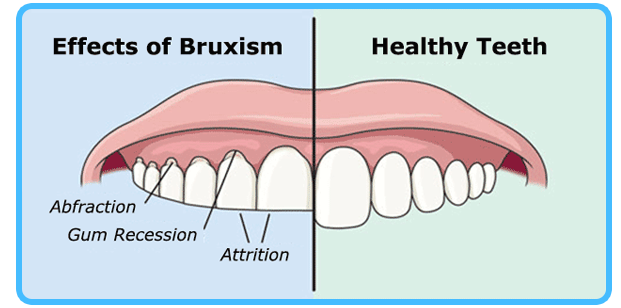
The term “bruxism” refers to tooth grinding and tooth clenching that many children and adults experience throughout their lifetime. Bruxism occurs when the teeth contact each other in a forceful fashion, this can be silent or cause a loud sound especially when sleeping.

Why Does it Occur?
Many medical and dental professionals may not always know the exact cause, but bruxism can occur due to psychological stress that people may be dealing with during the week. Stress can be categorized in two ways — by internal and external factors.

Internal factors could be the foods you consume, your level of fitness, your emotional stability, overall health and well-being, and the amount of sleep you get each evening. External factors of psychological stress include the environment you are in each day, interaction with others, when you are at home and how you deal with challenges on a daily basis.

Bruxism’s Impact on the Mouth
There are several elements that can occur in the mouth when people are experiencing bruxism:

  • Wearing away the tooth enamel and possibly the dentin
  • Cracking or chipping teeth, bridgework or implants
  • Tooth sensitivity can occur
  • Teeth can become painful or loose
  • Facial pain due to clenching of jaw muscles
  • Headaches
  • Overall facial fatigue
  • Pain in the temporomandibular joint (jaw bone on either side of the mouth)

Treating the Problem
Most individuals suffering from bruxism should see their dental professional/specialist to determine why they are experiencing this problem. Your dental professional may recommend that you wear a mouth guard or a night guard to cushion the clenching or tooth grinding during sleeping. Additionally, your dental professional may suggest ways to reduce stress so you can decrease the level of bruxism. You should consider avoiding foods such as chocolate and drinks that contain caffeine and alcohol. Avoid chewing forcefully and your dentist or oral maxillofacial surgeon may suggest conducting exercises to relax your jaw muscles during the day. If your bruxism is more severe, an occlusal splint may be recommended as well as medication prescribed to help relax you or make you sleep more soundly. Your dental professional will be able to work with you to find the cause and the solution to alleviate this problem.

Call Alivio Dental to schedule an appointment today! Proudly serving patients from Downers Grove, IL, Lisle, IL, Darien, IL, Lombard, IL, Clarendon Hills, IL, Bollingbrook, IL, Woodridge, IL, Westmont, IL, La Grange, IL and Wheaton, IL communities now.

Credits: Colgate-Palmolive Company

Teeth Alignment with Braces…

Posted on: 02.1.16 By admin

4.7 / 5 ( 3 votes )
Downers Grove Dentist Braces

Downers Grove Dentist Braces

Bringing Teeth into Alignment with Orthodontic Treatment

The American Association of Orthodontists reports that in the United States 4.5 million people are wearing braces or other dental appliances to straighten teeth and provide a healthy, beautiful smile.1. As many of us know, an orthodontist is a dentist with additional clinical training to treat malocclusions (improper bites), which may result from tooth irregularity and jaw issues.

Why Do Teeth Become Crooked?

Terry Pracht, DDS, past president of the American Association of Orthodontics says that both heredity and environmental factors can create crooked teeth and bite problems. Dr. Pracht mentions that hereditary factors include crowded teeth, teeth where there is too much space and malocclusions. He also mentions that crooked teeth can be caused by thumb sucking and tongue thrusting as well as accidents occurring to the jaw.1

What are Treatment Options to Straighten Teeth or Malocclusions?

There are three stages of orthodontic treatment. The first is when appliances are used to gain space in the mouth. For example, palatal expanders are used to expand the width of the palate and lingual bars are used to expand the lower jaw. The active corrective stage is next when the braces are placed on the teeth. The teeth are then adjusted and then straightened and malocclusions are corrected over a period of time based upon the severity of the irregularity of the teeth and jaw issues. The third stage is the retention stage after braces are removed and when the teeth are monitored through the use of a retainer (removable or fixed) and semi-annual orthodontic visits are conducted to maintain the straightened smile.

Types of Braces

Braces from over 30 or so years ago included large metal bands that were enclosed and cemented around each tooth. Braces can be attached to the cheek side of the teeth as well as the tongue side of the teeth depending on what your orthodontist recommends to you for treatment. Braces, arch wires and bands can be colorful and a lot of fun for children, adolescents and teenagers to choose from.

Today, tiny brackets are placed onto the front surface of the tooth and are made of metal or ceramic. The brackets are bonded to the front tooth surface with a glue-like material and metal bands can be used on the back teeth. Arch wires are placed inside the brackets and are made of a heat-activated nickel-titanium source that can become warm due to the temperature in the mouth, which will allow it to apply constant pressure on the teeth as well as when the arch wires are adjusted at the orthodontist’s office.

Another newer alternative to braces is the Invisalign® system which uses a series of clear removable aligners that are worn during the day and night to help in moving teeth into the correct alignment. When eating or brushing and flossing, the aligners may be removed.

Caring for Braces

Your orthodontist, dentist or dental hygienist will provide you with thorough instruction of how to properly clean your braces. There are many toothbrushes you can use both manual (specifically designed for orthodontic patients), power, electric or sonic. Ask your dental professional which is be best for you. Brushing should be conducted at least 2-3 times per day at a 45 degree angle in a back and forth motion. Be sure to remove plaque at the gum line to prevent gingivitis (inflammation of the gum tissue). Be sure to angle the toothbrush at the gum line and then gently brush around the brackets to remove plaque and food debris.

It is very important to clean in between your teeth with a floss threader and floss, a stimudent (tooth pick cleaner) or a proxabrush (interproximal cleaning brush) may be used if there is space between the teeth. Oral irrigators may be recommended to remove food debris and irrigate the gum tissue to remove disease and odor-causing bacteria that may be there if you have gingivitis. An antibacterial toothpaste and over-the-counter antimicrobial mouth rinses could also be used with the oral irrigator or alone.

How to Maintain a Smile After the Braces are Off

After your orthodontist has determined that your braces can be removed, it is very important that a retainer (a plastic appliance) be worn during the day or night as recommended by them. The retainer can be cleaned with warm water or toothpaste and a toothbrush after you wear it and placed in a plastic container when not in use.

See your dental professional for a twice a year professional cleaning and the orthodontist for regular maintenance appointments.

Call Alivio Dental to schedule an appointment today! Proudly serving patients from Downers Grove, IL, Lisle, IL, Darien, IL, Lombard, IL, Clarendon Hills, IL, Bollingbrook, IL, Woodridge, IL, Westmont, IL, La Grange, IL and Wheaton, IL communities now.

Credits: Colgate-Palmolive Company

Injured Tooth: What Should I Do?

Posted on: 01.25.16 By admin

4.7 / 5 ( 4 votes )
Woodridge dentist broken tooth

Woodridge dentist broken tooth

As with any trauma to the mouth, you should consult with your dentist immediately to determine if treatment is required. The dentist will examine the affected area and may take X-rays.

If you are in pain from a broken, cracked or chipped tooth, you may want to take an over-the-counter pain reliever. If possible, keep any part of the tooth that has broken off and take this with you to the dentist.

If a tooth is completely knocked out of the mouth by an injury, take the tooth to your dentist as soon as possible. It may be possible for your tooth to be placed back into your mouth, a procedure called reimplantation.

How Does a Dentist Treat:

Chipped tooth —If there is no pain and the chip is small, it’s up to you to decide if, when and how the tooth should be repaired. Depending on the size of the chip, it can be smoothed or cosmetically corrected. Other options include veneers, crowns and fillings. Ask your dentist to explain these options. If a filling or artificial tooth becomes chipped, it should be replaced.

Cracked or broken tooth —Cracked and broken teeth should be repaired as soon as possible to prevent further damage. Root canal therapy or tooth extraction may be necessary. If a crack affects the enamel and dentin of the tooth, a crown is frequently the best treatment. Keep in mind that cracks are not always visible, even on X-rays. Symptoms may involve pain while chewing and sensitivity to cold and possibly hot foods and liquids, as well as air, which may over time become more pronounced.

Tooth knocked out —The key to successfully reattaching a tooth is to get it reimplanted in the socket as soon as possible. With each minute that passes, more of the cells on the root of the tooth die. If possible, rinse the tooth with water only, then reimplant the tooth at the site and hurry to a dentist as quickly as possible. The tooth should be picked up by the crown only and must not be allowed to dry. The best chance for success is reimplantation within the first 30 minutes, with chances still good for up to two hours. It may be necessary for your dentist to do a root canal treatment one to two weeks after the tooth has been stabilized.

Permanently lost teeth, whether they’ve been removed by a dentist or accidentally knocked out, should be replaced. This is to avoid problems such as difficulty chewing and speaking, a shifting of position among remaining teeth, temporomandibular joint (TMJ) disorders caused by chewing on the side with more teeth, and a weakening of the jawbone. Options for replacing lost teeth include bridges, dentures and implants.

Broken jaw —If you suspect you or someone else has a broken jaw, do not move it. The jaw should be secured in place with a handkerchief, necktie or towel tied around the jaw and over the top of the head. Cold compresses should be used to reduce swelling, if present. Go immediately to a hospital emergency room, or call your dentist.

Call Alivio Dental to schedule an appointment today! Proudly serving patients from Downers Grove, IL, Lisle, IL, Darien, IL, Lombard, IL, Clarendon Hills, IL, Bollingbrook, IL, Woodridge, IL, Westmont, IL, La Grange, IL and Wheaton, IL communities now.

Credits: Colgate Inc

  • « Previous Page
  • 1
  • …
  • 8
  • 9
  • 10
  • 11
  • 12
  • …
  • 22
  • Next Page »
icon1

Schedule Appointment

icon2

Our Dental Blog

icon4

Visit Us On Facebook

Keywords

AAPD Aurora Dentist Brushing Dentists Downers Grove Dentist Pediatric Dental Care

© 2023 ALIVIO DENTAL, ALL RIGHTS RESERVED

  • Job Opportunities
  • Sitemap

Alivio Dental

Call our office today to schedule an appointment.
Alivio Dental - Downers Grove
7335 Lemont Road
Downers Grove, IL 60516
Phone: 630-884-8174
Fax: 630-343-9602


Downers Grove Dental Services
Google Reviews
4.7 out of 5 with 79 reviews

General & Cosmetic Dentistry Treatments

Aurora & Downers Grove Dentists, Dr. Kaur and her associates offers a full scope of general and cosmetic dentistry inlcuding deep cleanings, tooth fillings, tooth bonding, tooth sealants, root canal procedures, dental crowns, tooth extraction, dentures, veneers, inlays onlays, teeth whitening, dental bridges and is dedicated to providing you with a pleasant visit and results that you are proud to show off.

Proudly serving Aurora, Darien, Downers Grove, Naperville, Woodridge and the following DuPage & Kane County communities:

  • Aurora, IL
  • Downers Grove, IL
  • Woodridge, IL
  • Darien, IL
  • Aurora, IL
  • Bolingbrook, IL
  • Lisle, IL
  • Lombard, IL
  • North Aurora, IL
  • Clarendon Hills, IL
  • Westmont, IL
  • La Grange, IL
  • Naperville, IL
  • Wheaton, IL